
Design & ordering
Bracelet Sizing for Bulk Gift Orders
Plan bracelet sizes for a bulk gift order using wrist measurements, fit preferences and a clear size list. Avoid confusing bracelet length with inside fit.
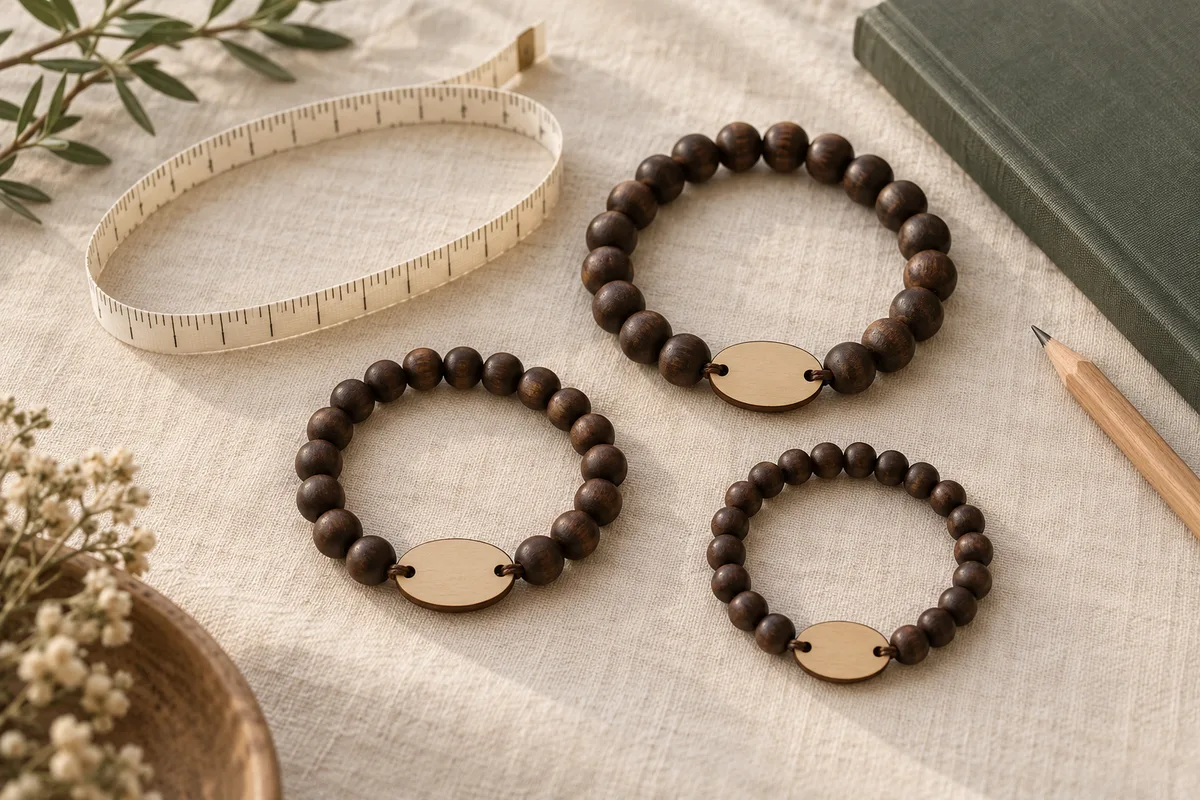
For a bulk bracelet order, collect wrist measurements and fit preferences, choose the construction, then confirm how the finished bracelet will fit. Do not treat a bead count, a flat length or a gender label as a universal size. The same apparent size can feel different when bead diameter, tag shape or closure changes.
This guide is about physical wrist fit. If you are deciding how many gifts to buy for an audience, use the separate event giveaway quantity guide. Both decisions belong in the order brief, but they answer different questions.
How do you collect a useful wrist measurement?
Ask each recipient to measure where they intend to wear the bracelet with a flexible measuring tape. The tape should sit against the wrist without squeezing it. Record the reading and its unit exactly, then ask whether the person prefers a close or relaxed fit.
A strip of paper or non-stretch string can work when no tape is available: mark the meeting point and measure the marked length with a ruler. Do not use elastic cord for the measurement. If someone measures in inches and another person in millimeters, label both clearly before converting anything.
Borsheims’ bracelet sizing guide likewise starts from wrist measurement and bracelet style. For a custom bead design, the important next step is supplier confirmation of the finished fit rather than borrowing a size chart for a different bracelet.
Which measurements must the order list distinguish?
Label measurements according to what they actually describe. An unqualified number such as “180” leaves the production team guessing whether it is a wrist, bracelet or design measurement. Use a consistent worksheet and keep fit preferences separate from the raw measurement.
| Field | What it records | Common mistake to avoid |
|---|---|---|
| Wrist circumference | Measurement around the recipient’s wrist | Adding an unexplained allowance |
| Preferred fit | Close, relaxed or a specific agreed preference | Inferring it from gender |
| Construction | Elastic or drawstring design | Assuming both fit identically |
| Production size | Supplier-confirmed dimension or size code | Treating an outside dimension as inside fit |
| Recipient reference | Name or private order identifier | Losing the link to personalized engraving |
| Status | Confirmed, awaiting measurement or spare | Hiding unknown sizes inside a confirmed total |
The production size becomes final only after it has been mapped to the selected design. Keep the original wrist measurement so any later change to the beads or tag can be assessed without asking everyone to start again.
Why does bead and tag geometry change the fit?
Beads occupy space between the cord path and the wrist. A larger bead changes that relationship, and a rigid tag spans part of the bracelet differently from a flexible run of beads. A simple bead-count calculation therefore does not prove a comfortable inside fit.
An elastic bracelet also has to pass over the hand. A drawstring design has its own opening and adjustment range. Ask about both wearing fit and putting the bracelet on, especially when the intended audience is not available for measurements.
Use the bracelet designer to establish the visual design and discuss its sizing settings with our team. A digital render helps communicate the choice; it is not a physical fit test or a guarantee of one size fitting every adult.
How can you organize a mixed-size order?
Separate confirmed fits, unresolved measurements and spares before finalizing quantities. A count that balances mathematically can still be wrong if the size definitions are unclear. The artwork list and size list should use the same recipient references.
For an illustrative 50-gift order, suppose 38 recipients have confirmed measurements, eight have not replied and four bracelets are intended as unpersonalized spares. The total is 50, but only the 38 measured entries are ready for a final size decision. The eight outstanding entries need a response or an agreed adjustable solution; the four spares need a deliberate size plan.
Once the supplier confirms the size breakdown, reconcile it back to 50 and check any names against the engraving list. If the bead design changes after that approval, revisit fit instead of assuming the previous breakdown still applies.
What should you do when recipient sizes are unknown?
Discuss an adjustable construction and its actual usable range, then plan how guests will select or exchange sizes at distribution. Do not invent a gender-based split to make an incomplete spreadsheet look finished. For a small client group, asking discreetly may be simpler than managing replacements later.
Confirm any physical sampling arrangement separately. A digital artwork proof checks appearance and spelling; it does not confirm wrist comfort. Any sample, first-article or fit-check arrangement needs its own agreed scope and timing.
Send the size worksheet with your branded bracelet brief, and use our contact page to resolve unknowns before production. Clear measurement labels are more valuable than a confident-looking size guess.
Frequently asked questions
How should someone measure their wrist for a bracelet?
Wrap a flexible tape around the wrist where the bracelet will sit, keeping it snug without compressing the skin. Record the measurement and units, then note the preferred fit separately. Ask the supplier how that measurement maps to the selected bracelet construction.
Is bracelet length the same as wrist size?
No. Wrist circumference measures the body; bracelet length or outer circumference measures the object. Bead diameter, tag geometry, cord and closure affect usable inside fit. Confirm which measurement a size label represents before ordering.
Can we choose sizes using men's and women's labels?
Those labels are not a substitute for measurements. Wrist sizes and fit preferences vary within any group. Collect measurements when possible, or agree a documented adjustment range and distribution plan for the actual audience.
Does an elastic bracelet fit everyone?
No. Stretch helps a bracelet pass over the hand, but it does not make every finished circumference comfortable on every wrist. Excess tension and a loose fit are both reasons to review the size. Confirm fit with the chosen beads and tag.
Is there one standard allowance to add to every wrist measurement?
No single allowance works for all constructions, bead diameters and preferences. Record the wrist measurement without silently adding your own adjustment, and let the production specification state the agreed fit allowance or target inside dimension.
Should we order spare sizes for an event?
Spare sizes can help when attendance or measurements may change, but the quantity is an event-specific decision. Separate confirmed recipients, unknown fits and unpersonalized spares in the order list. Do not assume an arbitrary percentage will suit every audience.
